From the memoirs of Thomas H H Bossingham describing his childhood visits to his Grandmother, Charlotte Mae Mackenzie, nee Allin in the 1920s
“FENSTANTON
The earliest recollection I have of Fenstanton was having a handful of gravel thrown against the window.
We, my mother, grandmother and myself must have gone down on holiday before my grandparents left Harrington Street to go and live in Fenstanton. Strangely enough I cannot remember the journey down. I can vaguely recall at some time seeing groups of men clearing the brooks and ditches and of being told they were German prisoners. Ma was scared of them, avoided going near them whenever she could and would never return their polite ‘Good mornings’.
We stayed with Mrs. Jacobs at the top of the hill, her husband Charlie, was the carrier, it was he who had thrown the gravel at our bedroom window, and his pony and trap were outside waiting to take us into St. Ives. It may even have been our journey home, I cannot remember, but I do have some very vivid recollections of arriving at Liverpool Street Station to find it packed tight with more German prisoners. We hurried away as the crowd were hissing and booing. I think it was Grandma who passed some remark about them being bits of boys.
We must have paid other visits too, because we stayed on other occasions with old Mrs. Jacobs whose home was the saddlers which was in the High Street right opposite a butchers shop. Here we were often wakened by the sound of sawing and chopping from the shop opposite.
We stayed on other occasions with Aunt Becky Allen. She was a relative of Grandma’s and lived with her husband in one of a row of cottages. I can remember here well. She was a quaint old lady with long ringlets. Uncle Bill, her husband was a tall bearded man and worked as a hedger trimmer, cutting the hedges all around. That was quite a skilled job, cutting out the weak growth and encouraging the more suitable stuff. A hedge, by hedge I mean a wild hedge trimmed and cut to grow where it was needed was a fine sight but rarely seen nowadays.
These cottages like so many more in the country had no bathroom, the water supply was an outside pump and the loo was a bucket in a little house down the garden.
My Father had stayed there with us as well. It must have been cramped; they were such tiny houses. Uncle Bill must have died between visits as I can remember seeing him there one time but not the other.
After her husband’s death, Aunt Becky took in a lodger. I only ever knew him as Fisher; he worked on the roads somewhere. He must have started work very early in the mornings as I can remember him coming in before we had our breakfast with some fresh mushrooms. He would arrive home again late in the evening to a dinner consisting of a huge dish of new boiled potatoes. He could eat as many himself as we had between us. My Father would often joke about it later whenever Ma served up a dinner where it was heaped up on a dish. He’d take the lot and say ‘Look – Fishers dinner’.
There was another woman living close by who intrigued me as a child. She invariably wore a hat and veil; she was the unfortunate sufferer of Kings Livid. That puzzled me a lot for years – Kings Livid – it sounded so mysterious and dreadful.
Aunt Becky’s house backed on to the Hall Green. Why Hall Green? This was an open field the centre of which was roped off, regularly cut and kept as the cricket pitch; there was also a pavilion. I have never been a keen cricketer but can remember some of those games. The home team would include the vicar, the blacksmith, a baker, a publican and several farmers and labourers. It was an event and had quite an audience. There were no other amusements so interest was keen, being picked for the team meant you were in. Occasionally too the Squire would attend and then everybody took care to behave. Everybody knew him and he knew everybody. In those days all the men without exception acknowledged him with a ‘Morning Squire’ and a touch of their cap.
On every visit to Fenstanton my Mother would look for Totty grass and Teasels. Totty grass only grew on the Hall Green and Ma would take us across there to search for this grass, she nearly always had a bunch at home, which she kept, in a vase. Teasels were practically anywhere, and we always had to take one or two home with us. I haven’t seen Totty Grass or Sucking Grass as it is known, for years, but have found Teasels all over the place. As a lad I had thought that the grass and Teasels only grew in Fenstanton.
It was near Hall Green that I saw my first Stoat. I was walking on the grass and not making a noise. I approached the gate that led on to a gravel path onto the road. As I reached the gate I thought I saw something move so crept up carefully to see what it was. There was this strange animal, a beautiful brown with a white front. It looked to me like a very skinny squirrel with no ears. It was running up and down the path stopping occasionally, sitting up and peering through the hedge. It did this several times until I must have moved or made a sound when it disappeared in a flash.
It was later when my grandparents moved to Fenstanton and from thereon for a number of years we stayed there for numerous holidays. I suppose we were fortunate in a way. We often had a fortnight at Yarmouth and then went on to Fenstanton. I grew to love that place. Heaven was Fenstanton to me. We travelled via either Huntingdon or Cambridge. At Huntingdon I could never understand why we had to walk the road from Huntingdon North to Huntingdon East. At Cambridge there was always a long walk along the platform from the main line to the branch line. All these little points were indelibly impressed on my memory on each in their way went to build up the holiday. We took all our belongings in a trunk, which came to be known as the terrible trunk after being mislaid on several occasions. When I sit and think there were several small episodes, which always recur. The time for instance when we left Hawkins Crescent in a horse cart. As we pulled away Dad noticed he had left the front door of the house open. Mrs. Croft our next door neighbour was waving goodbye. Dad had to shout to her to close the door for him. Another time, on Cambridge Station we had walked around to the local line, Dad had left a porter to bring the trunk. At the last minute he noticed that it wasn’t our particular trunk so had to go back for it. I saw him running down the platform with a porter as the train pulled out – how I cried – I thought we had lost him.
Whatever station we left from I had another momentary thrill watching a porter stick the label on our trunk, St. Ives – I was almost there when I saw that. The journey only took 2 ½ – 3 hours but what an age it seemed to me.
Then again, once on a journey home, Granddad came with us to Huntingdon, for some reason the guard was impatient and waved the train off before we got on to the platform. We had a three-hour wait. Gosh there was an almighty row, with Dad Granddad, the stationmaster and Mum.
As we reached St. Ives there were several landmarks to look for. Some years earlier there had been an aeroplane accident involving St. Ives church. The result was that the steeple was broken off half way down. Then there was Oakington Station where the station name was set out in big letters in the privet hedge. Just before entering St. Ives station itself there was an iron foundry. I was always interested in the plant that lay around. Over the long wooden bridge built across the river and extended over the fields because of the Ouse’s habit of flooding, then through the level crossing and into St. Ives.
St. Ives station was a weird arrangement, the station being a junction. In the booking hall you turned right for one line and left for the other. Once or twice I had seen baskets of racing pigeons released from here. The porter would carry them to the end of the platform, open the door in front and then bang the basket with his hand. There would be a whirr of wings; feathers and shavings would scatter everywhere as the pigeons took off to circle once or twice and then head for home.
Outside, the station appeared to finish to town in that direction. In the walls were several rings where people could tie up their horses, or ponies and traps while they went about their business. We would arrive to find Charlie Jacobs the carrier waiting to take us to Fenstanton.
The town never seemed to change. The cattle market stood on the left, an intricate pattern of iron rails forming a series of different sized pens for the various kinds of stock. It looked desolate now, but on Monday, market day it would be a seething mass of men and beasts as the dealers moved among the pens. Cromwell stood in the middle of the square pointing down to the ground. He appeared to be definite about something, but I don’t know what.
We turned left into Bridge Street, over the ancient stone bridge with it’s chapel in the middle overhanging the river and the V shaped indents at intervals where pedestrians could stand so as not to impede the traffic.
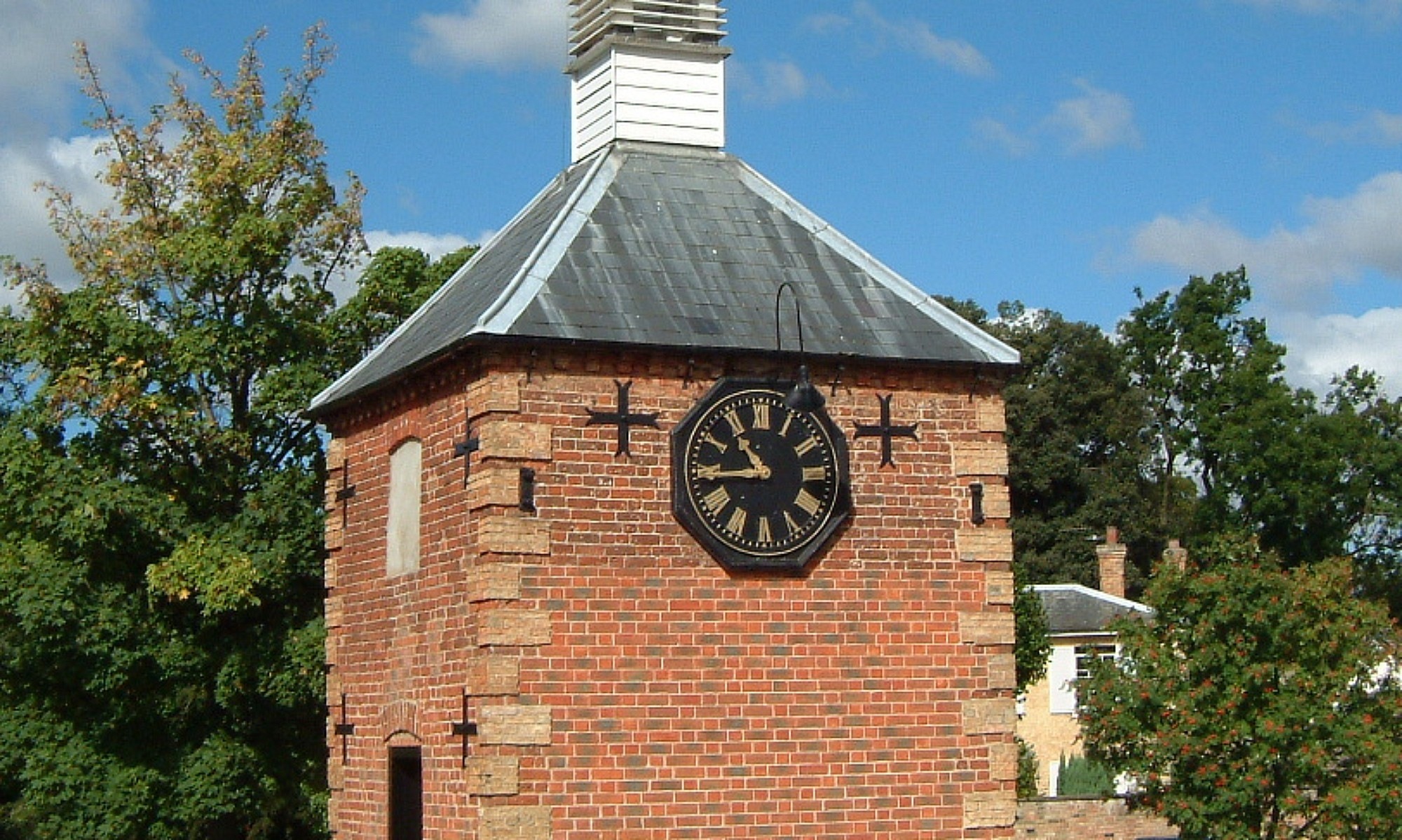
Crossing the railway again, but this time by the road over the same level crossing we had come in by. The Tollgate with its house was just below the bridge. It was no longer used and the gate stood idly against the wall. We turned left again into the low road into Fenstanton. The whole corner here was a vast Osier bed. Osiers looking like a bushy form of willow from which baskets were made. There was a path way through the Osiers that took quite a considerable distance off the walk into St. Ives. I can only remember ever going through there once or twice as Mum was scared of walking through there. It was rather cut off and the Osiers were over our heads so I suppose she had some excuse. It was supposed to be two miles into Fenstanton, but I think they were countrymen’s miles. Almost halfway along the road there was a small humped backed bridge, the sudden jolt over this was another reminder, we were nearly there! We were nearly there! Round the corner again, past the clock tower and into Hilton Road where stood Granddad’s house – we had arrived.
Directly opposite Granddad’s house were some farm buildings belonging to a Mr. Munns. He kept his stock elsewhere, but here he only had his hay and straw stacks, kept under cover as food and so forth for winter. There was some excitement one-day when it was suspected that one stack had been built with hay too wet and there was a danger of spontaneous combustion resulting. Men worked frantically for a couple of hours, enveloped in steam to demolish and scatter the stack.
The road eventually ran into Hilton, quite a long walk in fact. There was no footpath only a wide grass verge falling away into a ditch. To drain the roads there were small channels cut into the verge at regular intervals and we children would play at being horses, running along the verge and leaping the channels. We knew of a footpath off the road that ran through some fields belonging to another farmer Mr. Burgess. This footpath crossed two fields and went through some orchards. We were always very careful to keep to the footpath; it seemed the natural thing to do. It finally came out into a dead end road called West End for some unknown reason. There was a small brook here known as the staunch, this was crossed by a quaint wooden bridge. It was down West End that I once saw a family of Hedgehogs, Mum, Dad and about three youngsters go pattering across the road all in single file. Once in the Staunch while playing around I saw an enormous Perch. He must have weighed between 3 and 4 lbs., we looked at each other for a few seconds and then he swam off. It needed a bit of care to reach the water. The banks were very steep and about 8 – 9 feet deep, and were meant to carry away the floodwater. Usually in the summer when we were there the water was only 18 inches deep.
Going towards the main road from the house we first came to Mr. Banks the Cobbler. I have often sat in there watching him work and listening to the gossip. He worked sitting down with the last stuck in the top of a length of wood about 2’6” shaped to hold between his knees. There was a hole in the top and a metal collar fitted to take the stem of the last. He used a short handled broad-headed hammer and carried the nails in his mouth. During the war I knew a cobbler in Northern Ireland who worked standing up. His last was in a metal holder screwed down to the bench. The inside collar could turn any way for convenience. He kept the work steady by a length of rope, tied in a loop, which went over the instep of the shoe he was repairing, and under his own instep which he kept on the ground.
Further up the road was Jimmy Lansome. There was the old lady, his mother and Augusta (Gussie to everyone) his sister. Jimmy had several jobs. He was responsible for winding the clock in the tower; this stood on the green just across the road from his house. He was also the town crier. I have run around with him on several occasions when he had some announcement to make. He rode an ancient bike, which he mounted by putting his foot on the step (an extension of the rear hub) giving a couple of scoots and leaping forward on to the saddle from behind the bike. He rode to various points of the village rang the bell he carried and shouted out the announcement.
He kept a few chickens, but concentrated on dairy farming. He had about six cows, they all had names. When milking time came round we children would accompany Jimmy to the field where he kept the cows. All he needed to do was open the gate, the cows did the rest, but we would all be manned with sticks and quite convinced we had them all under control. They ambled along, all over the road, feeding here and there, as they liked. We might have to get them to one side for a car to pass, but it was very rare, the found their way home, each one into its own stall. Sometimes Gussie would fetch them. She would carry a small stick and scold the cows all the way home. “Daisy, you are a naughty girl. Brownie, you mustn’t eat the gentleman’s hedge. Bessie come out of there this minute,” and so on. We kids loved it. Some of the locals thought she was a bit off centre, but I don’t think she was, anyway we all thought the world of Gussie.
In the summer when we were usually there, the plums were ripening. We had to pass several orchards on the way there and back in order to fetch the cows. Jimmie was artful, he always managed to get his cows to wander into the orchards, and there he would help himself to a couple and give me some too. On the station too it was quite usual to see crates and crates of plums waiting to be taken to market somewhere. The porters would always manage to see that we each got a plum or two.
The milk at Lansomes farm was sold direct from the cows, no processing whatever, whether the cows were TB tested I don’t know, but everybody survived. I have often had a drink of milk all warm and frothy, like a present day milk shake, but in this instance straight from the cow. My Mother would visit the farm each evening with a jug and get her daily supply of milk. What wasn’t sold was left to stand in large earthenware shallow basins called ‘crocks’. It stood here until all the cream had risen, and then Gussie would skim it all off with a shallow sort of plate thing, all holes like a flat colander. The cream was used to make butter; the skimmed milk was fed either to the pigs or back to the cows. The old lady supervised the butter making. She was a bitter wizened old woman. She was old even when I first knew her, but she continued making butter until she was over 90.
The cream was poured into an old wooden milk churn. She would turn it for two or three hours and no one else was allowed to touch it. At first there was only a swishing noise as the cream slopped from one end to the other, but as cream began to solidify so the sound changed to a plop, plop as the lump of butter fell from end to end. There was a little peephole in the lid of the churn where it was possible to see how the operation was progressing. When she was satisfied, she divided the butter into two portions. One she took out for fresh butter, the other half in the churn and added salt for salted. After churning again, the fluid left was called buttermilk, very good for making scones etc. but terrible to taste or so I thought. This was either thrown away or fed to the pigs.
The next operation was quite hectic, she would knead and roll it like dough, thump and bash it about until all the moisture was out. She had her regular customers and knew just what they wanted. She would divide it all up into the various portions – always by eye – she only used scales to check the amounts and she was never far out.
I remember once going to market with Jimmy Lansome into St. Ives. He had three horses to sell. He rode one; I rode another and had the third on a halter. He lifted me on to my mount, but had to lead his round to the front door where there was a high step to enable him to mount. My saddle was a sack. Sitting astride this great horse was not at all comfortable, but I felt like a king, I wouldn’t have missed it for all the money in the world. Dad told me I looked like a fly on a bladder of lard. I don’t recall anything of the actual trip, but for hours afterwards my legs felt distinctly bandy and my backside was so sore I couldn’t sit in comfort.
A little further up the road was ‘Saints’ a sweet shop. There was in plaster over the door, very modern for then, I had never seen anything like it before. The couple who kept it were very ancient. We would buy a pennyworth of sweets there, all sorts and kinds, but we had to be crafty. We would try to fiddle it so that the old chap served us; he would always give us more than what the old lady did.
Across the road was the Smithy and the Post Office. The Postmistress knew everyone. She delivered some of the mail, but practically everybody else called in for theirs. Sometimes she would even run out into the street after someone. I was intrigued that if I just put Granddad’s name on a letter, with Fenstanton following, he would get it. The Blacksmiths were two brothers named Johnson, their mother managed the George Inn just a little further up the road on the other side. I have sat for hours in that Smithy on a bag of coke watching him shoe horses. If I let my mind wander, the clanging of the anvil, the sparks flying and the roar of the forges, he pumped the bellows seemed as real now as it did all those years ago. The smoke and smell of burning hooves as he fitted the red-hot shoe – another smell that I shall remember all my life.
Whether Smiths differed or not I don’t know, but I knew all his little ways and tricks. They wore split leather aprons, the horses hoof was lifted and brought up behind the smith and guided between his knees and held steady for him to work on. He had a large number of ready-made shoes for the farm horses, but for some of the lighter breeds he had to make shoes to fit. What calculations he made I never found out, but I only ever saw him measure across the widest part hoof. He’d cut a piece of metal, heat and shape one side, fit it, and then shape the other. After making, all that was needed he’d put them on four nails on the outer edge, three on the inner. The nails were a characteristic shape. I was always amused at school to take several home and see what the other boys thought they were. The nails were driven into and through the hoof where the end was twisted off with the claw headed hammer. The hoof was finally trimmed and filed to shape and brushed with polish. The knife he used to trim the hoof was an odd shape. A short curved blade curled at the end. I have often marvelled at those old horses, standing there so patiently, first one foot up, then the other, no fuss no bother, in fact at times I had since wondered whether in their way, if they treated the operation like a man treats a haircut!
Behind the forge, set in the ground was a large circle of concrete with a depression in the centre. I saw it used only once. The old farm cart had iron rimmed wheels and the slab was used to fit these. The Smith would make the rim to the necessary size on his anvil. He then had to stoke up his forge with a large quantity of coke which, when it was well alight he transferred to the slab outside. The iron rim in the meantime being already on the slab with the coke all round the outside. The heat expanded the rim, the wheel was then placed in position and the fire allowed to cool, whereupon it shrank onto the wheel and was fastened into position. Care had to be taken not to set fire to the wheel, lots of water was used to keep the wheel damp. There was steam everywhere, it usually took two or three men to do this.
These places all stood on the main road, Huntingdon to Cambridge. Over the years the traffic built up and Fenstanton was a bottleneck. We progressed and by pass was built round Fenstanton. It passes right through where Granddad’s house stood; it’s all gone now – everything. Where Granddad’s house was is now a subway to cross the road.
If we continued up the road we passed the Crown Inn, (incidentally in this one road there were once eight pubs), and the General Store known as Titmarshes after the name of the man who ran it. Here, you could and did buy everything.
Down Church Lane and into the churchyard, unfortunately very much overgrown now, but the old gravestones just as I remember them. My Grandma is buried there, no mark on the grave, but identified by the next but one to the left has a gravestone with the name Rhoda on it.
When Grandma was buried the hearse was a farm wagon all black and shiny, pulled along by eight men, the bearers. All the menfolk of the family walked behind the hearse, me included. The women either walked the short way or went by car. It was Granddad‘s wish that we went the long way round to the cemetery, and passed the house in Bell Lane where Grandma had been born.
It was in a field beyond the cemetery where I once went gleaning with my Mother and several old women from the village. These women walked round the field after the reaper picking up the wheat ears that had been missed and putting them into the pockets of big aprons which they all wore. They used the wheat as chicken feed. My Mother would sometimes even when out walking feel an ear of corn, rub it between her hands to loosen the husks blow all the chaff away and eat the remaining grains of wheat. It has quite a flavour.
On through the churchyard, past the West End door, where on Sunday mornings we could see the bell ringers, I knew several, standing in a circle round a board on the floor on which was painted the peal they were ringing. Just outside the churchyard was the school run by a Mr. Smart. There was only one class consisting of about 24 pupils all ages. I had to attend there for a few weeks when Grandma died and we stayed on there for a little time helping Granddad to sort things out. Mr. Smart had a lady teacher to help him, but all the pupils were taken together with some individual tuition for the older ones.
Mr. Smart was a beekeeper. I once saw him collect a swarm of bees that had settled in an apple tree in someone’s orchard. It was one great mass of bees all moving and milling around about twice the size of a football and making the noise just like and aeroplane engine. Mr. Smart arrived wearing the usual protective clothing that I have seen several times since. This consisted of a straw hat to which a veil was attached a pair of gloves and a hive, cone shaped and made of straw and a tin tray. He carried the ship or hive open side up to the bees, held it underneath the bees and gave the branch a good thump with the other hand, where upon the whole mass dropped off into the hive. He then placed the tea tray over the open end, tarred it up and carried it home.
Coming down the road we came to Mr. Jacobs’s house. He was the son of old Mrs. Jacobs with whom we had stayed earlier and lived in the High Street. Mr. Charlie Jacobs was the village courier. He had a pony and trap in which he would carry goods backwards and forwards to St. Ives. Collecting medicines, sending or collecting telegrams and parcels, shopping for old folk and so forth were his daily jobs, and when we went on holiday then he would take us out to Stray Farm and bring us back.
On the drive to Fenstanton we would go by the lower road, so called because in bad weather it was often flooded. There was also the high road; this was a little longer. On the lower road was the humped back bridge I have mentioned before. Mr Jacobs at that time had three sons, Charlie, Harry and Fred; I played with them in and around their barn often enough. Old Mr. Jacobs and his sons are dead now, but young Charlie still carries on the job of carrier only now he uses an old Bedford van in place of the pony and trap. I would give a lot just to ride once more round those familiar roads in a pony and trap again, with the dog running along between the wheels like I have seen so often. No rush, no hurry, no noise just a steady slip clop as we jogged along the road – bliss.
Mr. Jacobs kept pigs, along with chickens and a few cows, but pigs principally at that time. There was a practice then to put rings in the pigs’ noses to stop them digging up the ground. I was up at the farm one day when they decided to ‘ring’ the younger pigs. Each pig was brought in turn from the sty into the barn where Mr. Jacobs and some other chap grabbed hold of it between them, forced the open ring through the centre portion of its nose. It was then clamped shut with pliers and returned to another sty. This went on all the afternoon, the squeals and the mess – terrible.
Walking on down the hill we passed the Chapel on the left and then came to Mr. Hodges house opposite, and next door was his bakery, Mr. Hodges being the local baker. He baked several times during the week, the last being Saturday night. In the morning while the ovens were cooling numerous housewives from nearby would be seen hurrying up to the bakery with their Sunday dinners ready for baking to fit into Mr. Hodges ovens.
We next came to another pub, The Chequers. At that time in the back yard there was an enormous Mulberry tree. This incidentally was the first time I ever saw and tasted Mulberries. This pub was owned by a family named Barker who were also friends of my Grandparents. Mr. Barker was an enterprising man, and converted an old van into a bus. This became known as Barker’s Bus and plied between Fenstanton and St. Ives. Up until then there had been no regular transport. If you were lucky you might manage to get a lift from someone going that way otherwise you walked.
Monday was Market Day in St. Ives and practically everybody did their weekly shopping. A two mile walk into St. Ives and then back home again loaded with shopping was no joke, but it was done regularly many times by many many people and thought nothing of, it was essential and had to be done there being no alternatives. Mr. Barker knew all the regulars and where to pick them up. Others would meet at points along the way. It was quite usual for him to stop at an isolated spot waiting for old Mrs. So and so, to come across the fields. Everyone knew everyone else and everybody’s business; the bus was the only means of spreading local gossip. Women talked about their ailments and their children while the men discussed the weather, crops or each other’s animals.
We came next to the row of cottages where old Aunt Becky lived, where all the old folk were sitting at their front doors in the evening sun, passing the time of day with everyone who passed by. We reached the main road again, where Hilton Road turns off by the Doctor’s house on the corner and back to Stray Farm.
On Sundays we would all go to church with Granddad. We always went there by Bell Lane, passed the house where Grandma had been born and came home again along Church Lane. Everybody was dressed in their best, the men mainly in dark grey tweeds looking uncomfortable in collars and ties. The girls in cotton frocks, pinafores and big hats, black stockings and button boots. Mothers looking their smartest in a variety of clothes, and the boys in grey like their fathers, but wearing caps, short trousers with long knee length black stockings and stiff white collars. The church was gloomy inside because of the stained glass windows; goodness knows what it was like in the winter with oil lamps for lighting.
There was a Feast Day once a year when a travelling fair made a one-day stop. It was in a different field each year, how they arranged this I don’t know. This was quite an event and looked forward to and enjoyed by all the children.
After Granddad’s dog Lass died, he came by another; a small black terrier type called Nigger. He was like a cheeky little boy, always getting into mischief and being scolded. He and I got on very well together; we roamed all over the place. He was fairly obedient, but would take any opportunity of chasing the poultry and cows etc. This was a serious crime in the country and he was often beaten for it. He looked so forlorn and repentant afterwards that I didn’t have the heart to be angry with him for long. Once I remember he was chased by two greyhounds, they were gaining on him fast and I was scared for his safety, if they had caught him they could have torn him to shreds. Luckily he spotted a small hole in a wooden fence and shot through it leaving the greyhounds yelping and snorting on the other side. I felt very relieved, so did he I should imagine. A few seconds later, I was surprised to see him emerge from another hole in the fence about fifty yards further up the road and trot quietly off towards home – the greyhounds were still busy round the hole where he had disappeared. He liked chasing rabbits but never caught one. He would bound into the field, in those days most of the fields were alive with rabbits, and becoming excited at seeing so many would bark and chase around scaring them all away. He’d come running back to me, panting fit to burst, a yard of tongue hanging out and flop down whacked, he’d caught nothing but had enjoyed himself.
Speaking of rabbits reminds me of harvest time. At that time combine harvesters were something we had heard very little about. Some new fangled invention used on the farms in Canada. Harvesting then was more of a hazard than it is now. Reaping and binding machines, stacking machines and threshing machines were not that plentiful and had to be hired. The weather had to be just right too. The reaper would move in when the farmer thought the weather was right and begin cutting the corn. This machine would only cut the crop at ground level, tie it in bundles and toss it out on to the ground. These bundles had various names; it depended upon which part of the country you happened to be in. Here in Hunts. They were called sheaves. The men and boys would walk along behind stacking the sheaves into stooks, about six sheaves to a stook, all with the ears uppermost. This was a backbreaking job; it depended on the size of the field. Like all these old methods the farmer had to take advantage of the fine weather – hence making hay etc., and he and his staff would work from early morning until the light began to fade in the evening. All this time the reaper is going round and round, the remaining patch of corn getting smaller and smaller.
Some of the labourers came some distance, either walking or by bicycle, one or two may have been lucky enough to get a lift. They carried their lunch with them, consisting usually of bread and cheese and a bottle of cold tea. The locals were more fortunate, a few would be able to walk to their houses, and others would have their lunch brought to them by wives or children. A very welcome break after a hard morning to sit in the shade of some stooks and take refreshment followed by a smoke and a short doze, then off again. The labour was not organised then, unions were not so evident and I’m sure in such circumstances made for a happier life.
In those days mechanisation was negligible, life was slower, and the wildlife was more plentiful. It lived in these fields of corn; shelter and food right on the doorstep for a great many. As the standing crop became smaller and smaller with the reaper continuing its circular tour so the animals were driven in towards the centre. The locals knew from experience when to arrive, and arrive they did, all armed with sticks and accompanied by various dogs. Someone, generally the farmer would stay at the edge of the field armed with a shotgun, the young men and boys would follow just behind the reaper. As the crop dwindled so the animals were forced to run. There would be rabbits galore, a hare or two, an occasional fox and numerous birds, mostly Pheasants and Partridges. The excitement grew as the boys were streaking towards the hedgerows leaping over the sheaves, sticks flying, men and boys shouting and dogs racing about barking all adding to the apparent confusion as the rabbits were hunted down. Very few escaped, it all served a good purpose, food was provided for a great many and the farmer was rid of a pest for a while. Afterwards the boys would go through the village selling the catches for up to 6d a time and thinking they were well off. Nowadays most rabbits are bred for the table, then they were either caught with Ferrets or trapped and sometimes shot. It wasn’t uncommon in the latter to find one or two lead shot in the rabbit you were having for dinner.
After the crop had stood again in stooks, depending again on the weather and availability of the thresher it had to be gathered and stacked. Sometimes it was more convenient to bring the thresher to the crop than vice versa, also the size of the crop, how many others in the vicinity needed it and so on, and the whether the traction engine was available. The traction engines were adapted by the addition of a large flywheel to drive the various implements as well as tow them. The stacks were built either by hand using a gang of men with pitchforks who unloaded each cart and built as they went, or they used a stacker. This was an endless belt, with large comb like fixtures set at intervals along the belt. As it revolved the sheaves were dropped on to it one by one and deposited at the other end where the men would build the stack. The belt set in a framework was adjustable so as to be raised as the stack grew in height. The stack when built may also have to wait for the thresher, it would have to be built carefully and square so as not to topple, the sheaves all placed with the ears towards the centre. This served a double purpose; it helps the ears dry and also presented the various pests, birds and mice from taking too much.
On the threshing machine the sheaves were all fed into in one by one by hand on to a belt in to the machine where it was threshed. The chaff being blown to one side, the straw shot out the other side and the grain going down chutes into sacks at the other end. A long, dusty monotonous job.
The farm carts used for carrying the corn about had to have special racks fitted to the front and back to increase the carrying capacity. The total weight must have been quite considerable, but the old horse would plod patiently from stook to stook as it was loaded. I was in seventh heaven when I had the privilege of leading that horse around, not that he needed any leading, he probably knew the way better than I did. There was one particular old horse who was my favourite, they called him ‘Old Tom’, he was a grey and white dappled I think is the term. I found out after a while that if I stood against his shoulder as he waited to be loaded up and leaned against him slightly, he would alter his stance and lean on me a little. I did this several times; it was quite noticeable, because if I suddenly moved away, he had to correct his balance.
When work was finished for the day, he was unharnessed, and Jimmy Lansome would lift me up on to his back and lead us away to the field. As soon as he stepped the halter, Old Tom would manage a little canter into the field, give a whinny to welcome any other horses or cows who might be present. And then proceed to lie down, roll over and kick his feet in the air – I felt quite moved to see such a great loveable old horse so obviously enjoying the feel of the cool grass.
Regarding animals behaviour I once witnessed another peculiar phenomenon. I was in Mr. Holby’s farmyard; the chickens and ducks were all round me. It was quite usual for them to do so, they probably thought I had brought them some food. On this occasion I walked on and they scattered before me. Suddenly everything went quiet for a few seconds and then all crouched down to the ground giving a peculiar crooning sound, they looked frightened. What caused them to do this I don’t know, but I do vaguely remember seeing a large bird flying over – I have thought since then that it could have been some bird of prey.
Monday was Market Day in St. Ives, anybody having stock or poultry to sell had to have them in various pens ready sale before some prearranged time in order to have them checked and marked early for the auctioneer. The pens, different sizes for different animals were situated on two sides of the road. Cows and horses on one side, sheep on the other, while pigs were a little way apart on their own. Large trucks for transporting cattle were not very common then; consequently the stock had to be driven in on foot. It was the accepted thing to often stand in someone’s driveway should you suddenly be confronted by a heard of cows or sheep being driven along the road. Needless to say, this left the stalls and pens, and the streets in a considerable mess.
The pens were a complicated maze of alleys and gates, arranged so that each animal or group of animals for sale could be taken independently to the auction ring. Weighed, sold and then taken along by another maze of alleys and gates to further pens where they awaited collection by their purchasers. Pigs in quantity usually arrived by lorry, hurdles were arranged on each side to prevent escaping except into the pens. The doors of the lorry were opened and let down to form a ramp, then the fun began. Such a bedlam of noise and confusion, each pig seemed to have its own idea of what it wanted to do and where it wanted to go, each one being different from where the hurdles had decided they were going. The locals would stand around passing remarks amongst themselves and offering advice to the men handling the unloading. I can well remember one instance when watching this performance. One of the hurdles was inadvertently knocked over. In a second there was pandemonium, about half a dozen small squealing pigs had escaped. The immediate vicinity looked like a battlefield, there were men running about shouting and waving sticks in every direction and at least a dozen sprawled on the floor in their vain attempt to stop or catch the little escapees.
The cows were housed in similar pens only larger and were bought one by one through the maze on to a scale where their weight was shown for all the prospective buyers to see. After weighing they were let into a small ring where a handler kept them on the move while the buyers seated around in tiers could make their bids. Afterwards they were led off to await collection. Having their pedigrees and history’s read out followed by the parade around the ring reminded me somewhat of the similarity to the Miss World Contest.
It was possible to walk round the pens outside before the sale and see all the beasts. Here it was easy to tell the difference between locals and visitors. The locals would keep to the centre of the various aisles, while the visitors tended to keep closer to the pens. From long experience the locals had learned about the uncertain habits of these beasts in their strange surroundings.
Poultry and rabbits were all visited by the auctioneer in their turn. Poultry in most cases being bought by dealers but occasionally for egg producing. Rabbits I expect were bought for pets I can not imagine them being fattened for the table.
There was a wonderful sweet stall there. All sorts of home made sticky sweets. This man would draw the crowds by using a small boy. He would begin by describing one particular sweet and then place it between the lad’s front teeth; he did this several times until the lad was unable to open his mouth any further. Having attracted the crowd the lad would be dismissed with several more sweets and the man went on to sell his stock by mock auction. I envied the lad often but was never allowed to participate.
Our connection with the Jacobs family is explained by the fact that old Mr. Jacobs; the present families’ grandfather had been my grandmother’s first sweetheart. He was a tall man with a beard, not unlike old King George in appearance. He was a saddler by trade and kept a little shop in St. Ives where the Co-op now stands. There were numerous articles of harness and saddlery hanging about waiting to be repaired. He repaired all sorts of leatherwork apart from boots and shoes. The shop had an interesting look about it, I would have loved to poke about inside but was never allowed to do so. It had a peculiar smell about it, the smell of real leather. He used a variety of strange tools, and peculiar glove like things for his hands reinforced here and there for the various tasks he performed. One implement I was intrigued by was what looked like a gigantic pair of wooden tweezers about three or four feet long. I can remember seeing several of these things in various sizes. They were used to hold edges of leather together while he stitched them by hand. The jaws were forced apart and the leather inserted where it was held tightly in the required position while he worked on it.
Granddad eventually reached an age where it was not right to expect him to live and look after himself, so he was taken under the care of Nell his eldest daughter. Our visits to Fenstanton ceased, I was growing up and the attraction was not so strong. Many years were to pass before I visited there again.”